We
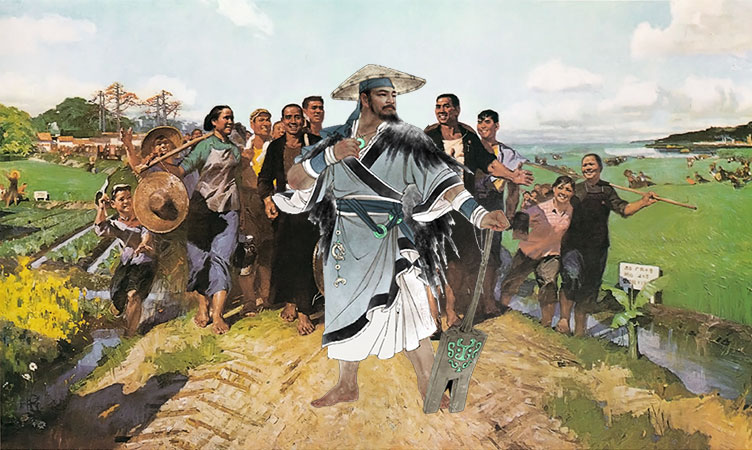
know very few positive facts about Mozi (ca. 480-392? BCE), but there
do exist a number of unsubstantiated anecdotes about him. He probably
flourished shortly after the death of Confucius, and shortly before the
birth of Mencius. As rumor has it, he studied under the Confucian
School when he was young, but soon turned away from this teaching and
launched a severe attack on Confucianism. He was particularly intent on
spreading his teaching of universal love and mutual benefits, and he
spent a major part of his life forestalling offensive warfare. He was
allegedly an expert in constructing defensive apparatus, and trained
his students to use them ably. He probably had hundreds of followers in
his lifetime; many among them carried out his anti-war ideology and
assisted in defensive warfare. He and his followers practiced an
austere lifestyle; they wore coarse clothes, eschewed personal
possessions, and traveled extensively to help others. Mohism attracted
a large following for some hundreds of years. Mohists formed a rigid
organization, with authoritative “Grand Masters” acting like military
commanders. For some time, Mohism and Confucianism were seen as the two
dominant schools in China. (ICP, 108)
 |
|
Universal Love
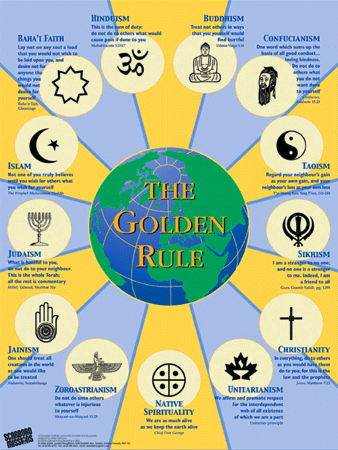
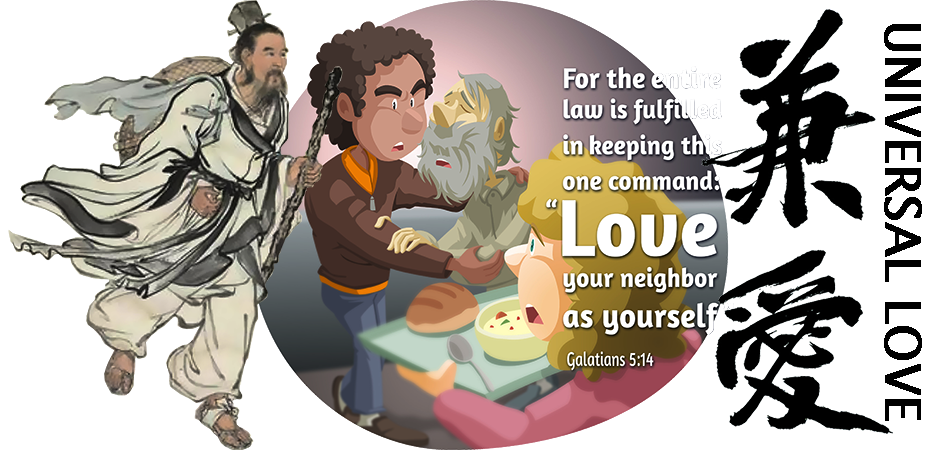
The hallmark thesis of Mozi is his teaching of “universal love,” as a direct challenge to the Confucian teaching of
love with distinctions. Mozi did not merely advocate that we
demonstrate universal concern for all people; he promoted the ideal of
treating everyone else just as we would treat ourselves. “Universal
love” means loving everyone, family members and strangers alike, equally. (ICP, 110)
It is the
business of the benevolent man to try to promote what is beneficial to
the world and to eliminate what is harmful. Now at the present time,
what brings the greatest harm to the world? Great states attacking
small ones, great families overthrowing small ones, the strong
oppressing the weak, the many harrying the few, the cunning deceiving
the stupid, the eminent lording it over the humble — these are harmful
to the world. So too are rulers who are not generous, ministers who are
not loyal, fathers who are without kindness, and sons who are unfilial,
as well as those mean men who, with weapons, knives, poison, fire, and
water, seek to injure and undo each other. (ICP, 110-1 [Mozi 16: Universal Love, Part 3]; cf. SCT, 69-70)
|
Do we have an ethical obligation to
"promote what is beneficial to the world and eliminate what is harmful"?
If so, how should we go about it?


When we inquire into the cause of these various harms [i.e. great states attacking small ones, great families
overthrowing small ones, the strong oppressing the weak, the many
harrying the few, the cunning deceiving the stupid, the eminent lording
it over the humble],
what do we find has produced them? Do they come about from loving
others and trying to benefit them? Surely not! They come rather from
hating others and trying to injure them. And when we set out to
classify and describe those who hate and injure others, shall we say
that their actions are motivated by universality or partiality? Surely
we must answer, by partiality, and it is this partiality in their
dealings with one another that gives rise to all the great harms in the
world. Therefore we know that partiality is wrong. ...
Partiality should be replaced by
universality. But how can partiality be replaced by universality? If
men were to regard the states of others as they regard their own, then
who would raise up his state to attack the state of another? It would
be like attacking his own. If men were to regard the cities of others
as they regard their own, then who would raise up his city to attack
the city of another? It would be like attacking his own. If men were to
regard the families of others as they regard their own, then who would
raise up his family to overthrow that of another? It would be like
overthrowing his own. Now when states and cities do not attack and make
war on each other and families and individuals do not overthrow or
injure one another — is this a harm or a benefit to the world? Surely
it is a benefit. (SCT, 70 [Mozi 16: Universal Love, Part 3])
|
|

|
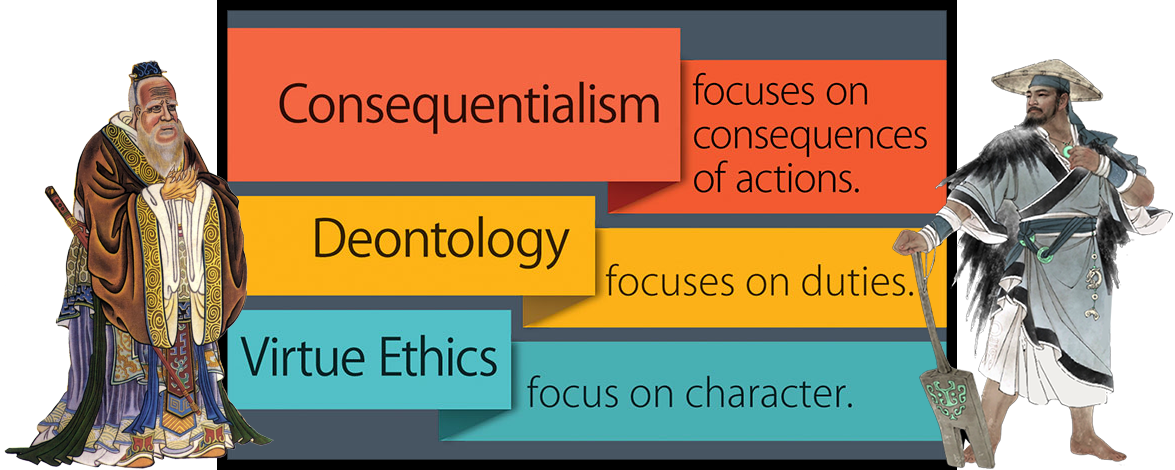
Consequentialism vs. Deontology & Virtue Ethics
Confucians are concerned with people’s morality,
while Mozi was only concerned with their survival; Confucians want to
teach people to act in accordance with righteousness, while Mozi wants
to teach them to act in keeping with general benefits. This is what
separates Mohism from Confucianism.
Mozi’s starting assumption is that all humans are naturally egoistic. We may say that he is a psychological egoist; he believes that all men are self-interested by nature. However, he is not an ethical egoist, since he does not believe that just because we are naturally self-interested, we ought to be self-interested. Mozi himself is an ethical altruist.
But how could he get other self-interested people to agree with his
position? From the assumption of psychological egoism, he tried to
promote the idea that the highest self-interest for everyone comes from
everyone’s benefiting others. In other words, what he promotes is a
paradoxical assertion that the best way to promote our self-interest is
to not promote our self-interest, but to promote others’ interests. (ICP, 115)

Now
what does Heaven desire and what does it hate? Heaven desires rightness
and hates what is not right. Thus if I lead the people of the world to
devote themselves to rightness, then I am doing what Heaven desires. If
I do what Heaven desires, then Heaven will do what I desire. Now what
do I desire and what do I hate? I desire good fortune and prosperity
and hate misfortune and calamity. If I do not do what Heaven desires
and instead do what Heaven does not desire, then I will be leading the
people of the world to devote themselves to what will bring misfortune
and calamity.
How do I know that Heaven desires rightness
and hates what is not right? In the world, where there is rightness
there is life; where there is no rightness there is death. Where there
is rightness there is wealth; where there is no rightness there is
poverty. Where there is rightness there is order; where there is no
rightness there is disorder. Now Heaven desires life and hates death,
desires wealth and hates poverty, desires order and hates disorder. So
I know that Heaven desires rightness and hates what is not right. ( SCT, 73 [Mozi 26: The Will of Heaven, Part 1]; cf. ICP, 117)
The intent of Heaven does not desire that
large states attack
small ones, that large families overthrow small ones, that the strong
oppress the weak, the cunning deceive the stupid, or the eminent lord
it over the humble. This is what Heaven does not desire. But this is not
all. It desires that among men those who have strength will work for
others, those who understand the Way will teach others, and those who
possess wealth will share it with others. It also desires that those
above will diligently attend to matters of government, and those below
will diligently carry out their tasks. If those above diligently attend
to matters of government, then the state will be well ordered. If those
below diligently carry out their tasks, then there will be enough
wealth and goods. ( SCT, 74 [Mozi 27: The Will of Heaven, Part 2])
Is this "ethical egoism" or "ethical altruism"?

Is Mozi's argument convincing?
|
|

|
|
Philosophy of Religion
Heaven, Ghosts and Spirits, Fate
Mozi seemed to be the most religious among
ancient philosophers, but his religious spirit was again prompted by
his pragmatism. He argued for the existence of ghosts and spirits and
advocated reverence for the Will of Heaven, not because he was
superstitious, but because he thought that these beliefs would help
promote universal benefit. By the same token, he argued against the
existence of fate and the belief that our life is determined by
pre-existing destiny, not because he was rational, but because he
thought that such beliefs would be detrimental to social welfare.
Mozi listed three criteria for testing whether a
theory is acceptable: (1) the origin of the hypothesis; (2) the
validity of the hypothesis; (3) the pragmatic results of applying
the theory. He says:
| We must
set up a standard of judgment. ... Therefore a theory must be judged by
three tests. What are these three tests of a theory? Its origin, its
validity, and its applicability. How do we judge its origin? We judge
it by comparing the theory with the deeds of the sage kings of
antiquity. How do we judge its validity? We judge it by comparing the
theory with the evidence of the eyes and ears of the people. And how do
we judge its applicability? We judge it by observing whether, when the
theory is put into practice in the administration, it brings benefit to
the state and the people. This is what is meant by the three tests of a
theory. [Mozi 35: Against Fatalism, Part 1] |
... [M]ost
interestingly, Mozi advocated that we judge whether a theory is
acceptable by checking to see how pragmatic it would be for us to
believe in the theory — how much utility is generated by its
acceptance, or its rejection. What is implicit in this view seems to be
what we nowadays call a pragmatic theory of truth,
which is the theory that a belief is true when it is useful to the
believer — the believer’s acting upon it would yield satisfactory
practical results. Under Mozi’s pragmatic theory of truth, many
philosophical debates would be settled, not on the soundness of the
argument or the completeness of the theory, but on each theory’s
applicability and its practical consequences. ... In his arguments, he
often appealed to the benefits of believing in the existence of Heaven
and Heaven’s will. If the rulers believed that there were Heaven and
that Heaven’s will were to “promote what is beneficial to the world,”
then they would not bring harm to the people; if the people truly
believed that there were Heaven and “Heaven desires righteousness and
hates unrighteousness,” then they would not do anything bad. Mozi thus
concludes: isn’t this a beneficial doctrine?

Is the "pragmatic theory of truth" convincing?
Is it relevant in contemporary society?
|
|
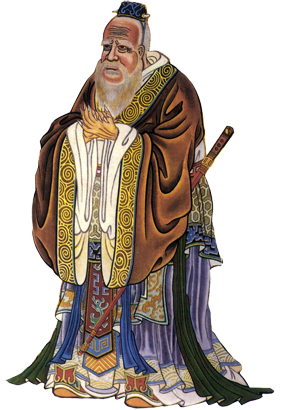
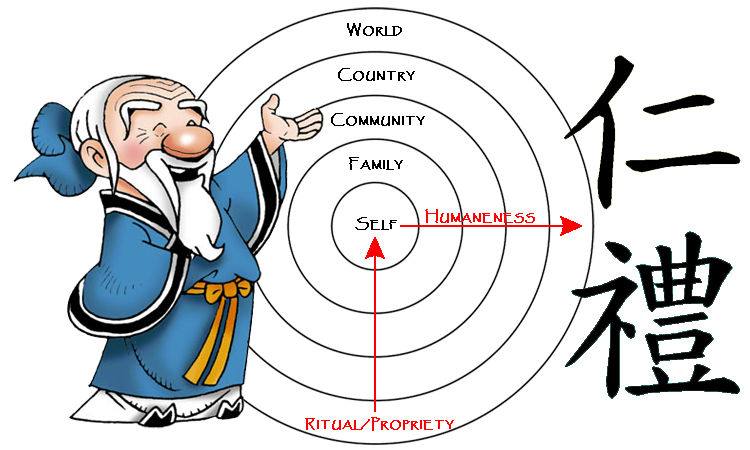
Mozi vs. Confucius
What
Confucius aimed to establish was a civilized society regulated by
rituals, rites, and music. What Mozi tried to restore, in contrast, was
a much more modest form of a meterialistically self-sufficient society.
Schwartz points out that in Mozi’s times, “there is a much greater
sense of urgency — one must almost say desperation — concerning the
task of meeting the elemental needs of the people for food, shelter,
clothing, security, and peace. Nothing less than a total and sustained
concentration of all the energies of the society [is] required to
attain this goal.” Perhaps it is rather because of this sense of
urgency that Mozi launched his attack on the social practices of
elaborate funerals, the production and enjoyment of music or dance,
along with his criticism of the manufacture of luxurious goods. He
asks: “What is the purpose of making clothing? to keep out the cold in
winder and the heat in summer. ... What is merely decorative and does
not contribute to these ends should be avoided.” If basic things such
as food and clothing should be kept at the minimal level, then other
things not crucial to survival must all be even more worthless.
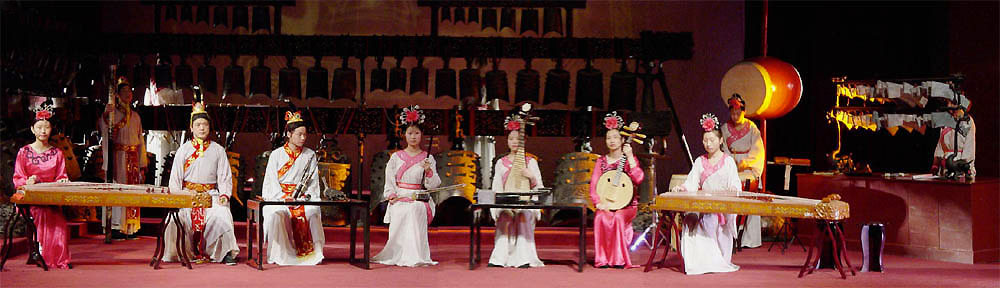
Mozi thought that music may be entertaining, but it does not serve any pragmatic function in people’s lives. He says:
There are
three things that people worry about: that when they are hungry the
will have no food, when they are cold they will have no clothing, and
when they are weary they will have no rest. These are the three great
worries of the people. Now let us try sounding the great bells,
striking the rolling drums, strumming the zithers, blowing the pipes,
and waving the shield and axes in the war dance. Does this do anything
to provide food and clothing for the people? I hardly think so.
|
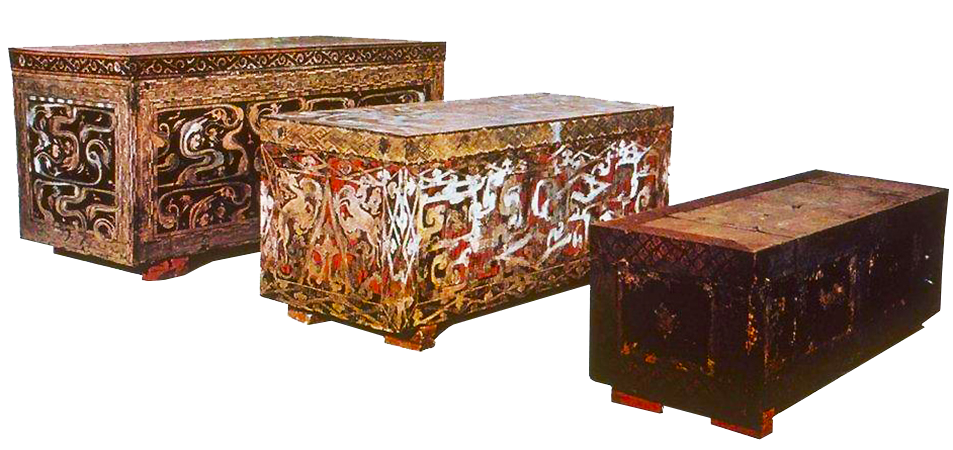
... Mozi further
criticized the Confucian insistence on propriety with respect to
funerals. The Confucian teaching on funerals is that they represent the
civility of human beings, which elevates us from mere beasts. A proper
funeral procedure and the fixed duration of the mourning period enable
us to express our sentiments toward the deceased in a socially
acceptable manner. But Mozi thought that all these rituals and rules
are a waste of social resources such as labor and money. He says:
[W]e
see that in elaborate funerals much wealth is buried, while lengthy
mourning prevents people from going about their activities for long
periods of time. If the wealth and goods that have already been
produced are to be bundled up and buried in the ground, and the means
of future production are to be prohibited for long periods of time, and
one still hopes in this way to enrich the state, then it is like
prohibiting planting and still hoping for a harvest. One could never
acquire wealth that way.
|
... Herlee Creel says,
“[Mozi] conceived of a world at peace, in which a large and orderly
population was adequately clothed and fed, as enjoying the best
possible state of affairs.” But is this state “the best possible state
of affairs”? From our contemporary perspective, even after reviewing
all the miserable human conditions in history, many still would not
embrace such a modest aim. (ICP, 122-4)
|
|